
Why Sand or Grit Shows Up in Well Water (And What It Costs You)
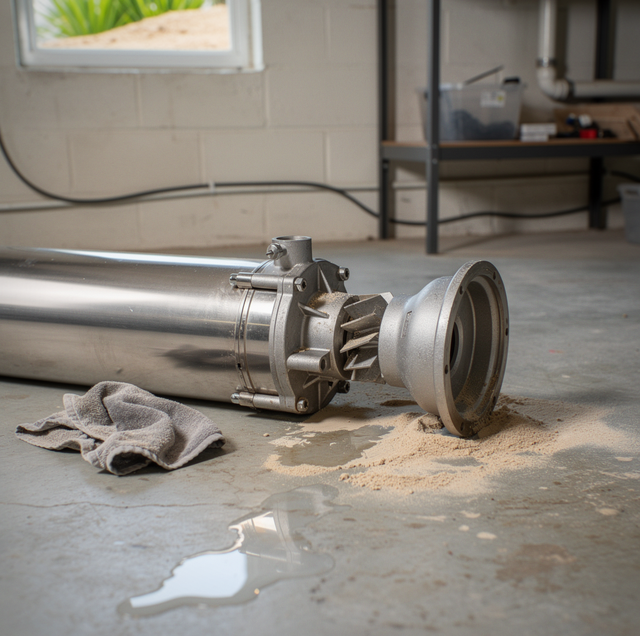
Many homeowners assume that if well water looks clear in a glass, it's fine, and that grit only becomes a problem once you can actually see it settling at the bottom of a pitcher. That assumption misses how sediment moves through a well system. By the time sand is visible to the naked eye, it has usually already been passing through the pump, the check valve, and every fixture in the house for weeks or months, wearing components that never show it until something breaks.
Grit in well water isn't a cosmetic issue. It's mechanical evidence that something upstream, at the pump, the well screen, or the intake point, is letting solid material into a system that was designed to move only water.
Where the sand is actually coming from
A well draws water through a screen, a slotted section of pipe near the bottom of the well that's sized to keep the surrounding sand and gravel out while letting water through. Two things typically break that filtration. First, the screen itself can degrade over years of exposure to mineral-laden water and fine sediment, developing slots wider than its original spec or outright corrosion holes. Second, a pump set too close to the bottom of the well, or set below the level the well was designed to draw from, pulls water (and whatever's suspended in it) from a zone with a much higher concentration of fine particles than water drawn a few feet higher.
Sandy, loosely consolidated aquifer formations make both problems worse than they'd be in solid rock. Fine sand migrates more easily through a marginal screen, and a pump intake positioned even a little too low sits in a zone where sediment settles and concentrates. That's why grit complaints often show up gradually as a well ages, rather than all at once.
The myth that clear water means a healthy system
Water can run clear from a tap and still be carrying enough fine sediment to sandblast a pump's internal components. Particles fine enough to stay suspended, silt and very fine sand, don't always settle fast enough to look cloudy in a glass, especially right after the water leaves the faucet. A homeowner testing water by eye alone can miss exactly the sediment size that does the most mechanical damage, because the coarser grains that are easy to see and feel in the sink often settle out of the system (or get caught by a sediment filter) before they ever reach a fixture, while the fine fraction rides straight through.
That's the gap between "the water looks fine" and "the system is fine." A pump that's ingesting fine sediment constantly is wearing its impellers and seals whether or not anyone notices grit in a glass.
What sediment actually does to the pump
Every impeller stage inside a submersible pump spins inside a close-tolerance housing, and the clearance between the spinning and stationary parts is measured in thousandths of an inch. Sand and grit passing through that clearance act as an abrasive, gradually widening the gap and rounding off the sharp edges the impeller needs to move water efficiently. As that clearance widens, water slips backward through the gap instead of being pushed forward, so the pump has to work harder and run longer to deliver the same pressure. Left unaddressed, sediment eventually scores the shaft seal enough to let water intrude into the motor housing, which is a failure mode that ends a motor's life outright rather than just reducing its output.
Sediment doesn't stop at the pump. Check valves and foot valves, which rely on a tight seal to hold pressure in the system when the pump shuts off, wear the same way; a valve with sand-scored sealing surfaces starts leaking back, which shows up as pressure loss and more frequent pump cycling.
Distinguishing a screen problem from a pump-placement problem
The two most common sources of sand intrusion, a degrading well screen and a pump set too low, produce slightly different patterns worth noting when describing the problem to a technician. A screen failure tends to bring sand intrusion that gets steadily worse over months as more of the screen deteriorates, often accompanied by a drop in the well's overall yield as more of the surrounding formation collapses into the screened section. A pump-placement issue is more likely to show up as sediment tied closely to drawdown, meaning grit gets noticeably worse during periods of heavy pumping (irrigation cycles, multiple fixtures running at once) when the water level in the well drops and the pump intake sits closer to a higher-sediment zone. A technician differentiates the two by pulling the pump for inspection and, where needed, running a camera down the well casing to check the screen's actual condition.
What a full sediment inspection actually involves
A thorough look at a sand complaint goes past pulling the pump for a visual check. A technician typically runs a drawdown test first, measuring how far the water level falls under sustained pumping, since that number determines whether the pump's current depth still leaves enough clearance above a high-sediment zone. Pulling the pump also allows a direct look at impeller wear and shaft seal condition, which tells the technician how much mechanical damage the sediment has already caused versus how much time is left before a seal failure lets water into the motor housing. Where the screen itself is suspect, a downhole camera run gives a direct view of slot condition and any corrosion, rather than inferring screen health from symptoms alone. Well sleeving, inserting a smaller-diameter liner inside a degraded casing or screen section, is one option a technician may recommend when the original screen has broken down enough that patching individual sections no longer restores reliable filtration.
Filtering symptoms without fixing the source
A sediment filter installed at the point where the water line enters the house catches grit before it reaches fixtures and appliances, and it's a legitimate, useful piece of equipment. But a sediment filter downstream of the pump does nothing to protect the pump itself; by the time water reaches the filter, it has already passed through every close-tolerance part inside the pump housing. A filter manages a symptom at the point of use. Correcting a degrading screen, adjusting pump placement, or in some cases sleeving the well to restore a tighter filtration barrier addresses where the sediment is entering the system in the first place.
Frequently Asked Questions
Yes. Fine sediment that makes it past the pump settles inside a water heater's tank, where it insulates the bottom from the heating element and forces the unit to work harder and run hotter to reach the same temperature; it also accumulates inside washing machine valves and ice maker lines, both of which have narrow orifices that clog faster than a kitchen faucet would.
There's no truly "normal" amount of sand that should reach a faucet; a properly screened well with correctly placed pump equipment should deliver water essentially free of visible grit. A practical way to gauge it without lab testing is watching how fast a point-of-entry sediment filter cartridge loads up: a cartridge that stays clean for two to three months is typical, while one that turns visibly brown and needs replacing every few weeks signals a sediment load well above what a healthy well should be producing. That filter-life pattern is often the first concrete evidence sediment intrusion is worsening, well before it's obvious at the tap.
Not always. Sediment can also enter through a poorly sealed well cap, a cracked casing above the screen, or construction debris left in the well from the original drilling process that gradually works its way to the surface over years. A full inspection rules out these alternative entry points rather than assuming the screen is automatically at fault.
A softener is built to exchange dissolved hardness minerals, not to filter out solid particles, and passing sandy water through a softener's resin bed can actually damage the resin and foul the control valve over time. Sediment needs to be removed by a dedicated sediment filter or settling system upstream of any softener or treatment equipment.
Fine sediment that has settled to the bottom of the well casing or inside the pump housing during idle periods gets stirred up the moment the pump starts pulling water again, producing a short burst of grit that usually clears within the first minute of steady flow; sediment that doesn't clear and continues through sustained use points to an active intrusion problem rather than settled particles being disturbed.
In many cases, yes. A technician can often raise a pump's mounted depth within an existing well casing to sit farther above a high-sediment zone, provided the well's water level and drawdown characteristics still allow adequate submergence for reliable operation; this is typically evaluated alongside a drawdown test rather than assumed to work for every well.
Sediment in well water is a symptom with a mechanical cause sitting upstream, at the screen, the casing, or the pump's position in the well, and it's worth tracing back to that source rather than treating the grit itself as the whole problem. A pump that's quietly ingesting fine sand today is on a shorter service-life clock than one drawing clean water, even while the tap still looks fine.
Get your well's sediment source identified before it wears through a pump - a technician can inspect the screen, check pump placement, and run a drawdown test in one visit. Pump Repair Services serves Apopka and the surrounding Central Florida area. Call (407) 625-5499.
