
Well Pressure That Surges Then Drops? Why It Won’t Hold Steady
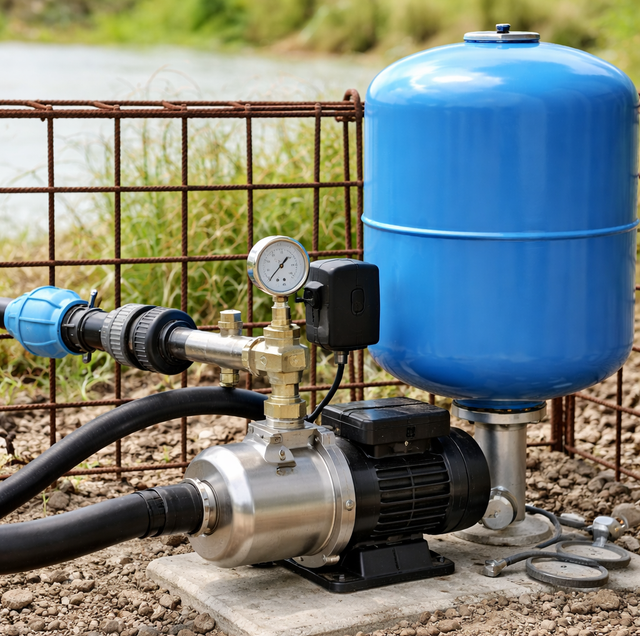
You step into the shower, and the water comes on strong, almost too strong, then a few seconds later it fades to a limp trickle. You wait it out; the pressure surges back, and the cycle repeats: hard, soft, hard, soft. The whole time you are trying to rinse. Or the opposite happens, where firm pressure never shows up at all, just a tired flow that barely clears the soap. Either way, the well is no longer handing you the steady pressure it used to.
Fluctuating pressure and weak pressure are two different complaints that point to different faults, but they share a root. A well does not push water on demand the way a city main does. It holds pressure inside a set range, so steady flow at your faucet is the result of a few parts staying in balance. When one drifts, you feel it at the showerhead as a surge, a sag, or a slow fade. Knowing how that balance works lets you tell which part slipped.
What "Steady" Actually Means at the Tap
Three parts share the job: the pump, the pressure switch, and the pressure tank. The pump lifts water from the well and builds pressure. The switch decides when the pump runs, turning it on at a low number called the cut-in and off at a high number called the cut-out. Common pairs are 30/50, 40/60, or 20/40 pounds per square inch, a spread of about 20 psi. The tank stores water under a cushion of compressed air, and that air charge is normally set about 2 psi below the cut-in.
The pump fills the tank until pressure reaches cut-out, then shuts off. When you open a faucet, the compressed air pushes water out while the pump rests. The volume you draw before pressure falls back to cut-in is the drawdown, several gallons on a healthy tank. So the pressure at your shower is never one fixed number: it rides the band between cut-out and cut-in, and it feels steady because the band is narrow, the tank smooths the swing, and the pump refills fast enough to keep up with the gallons per minute you draw. Break any part of that, and the band stops behaving.
When the Pressure Switch Is Reading Wrong
The switch is the cheapest part in the chain and a common reason pressure misbehaves, in two ways.
Set to the wrong numbers: If the cut-out is set low, the pump quits building pressure too early and every fixture feels weak, though nothing is broken. If the spread between cut-in and cut-out is narrowed, from 20 psi to a handful, you feel the swing more sharply because pressure never settles. Both are adjustment problems, sometimes left from a previous repair, sometimes from a spring weakening inside the switch.
A fouled sensing port: The switch reads pressure through a small opening and a short tube. Dissolved iron, mineral scale, and fine grit can pack that port until the switch senses pressure late and erratically. Water heavy in iron or sediment clogs it fastest, and the result is pressure that jumps with no rhythm you can predict.
A Tank That Can No Longer Smooth the Swing
A pressure tank that has lost its air charge is the classic cause of surge-then-sag, and it earns a mention here even though it has an article of its own. When the air cushion bleeds off or the internal bladder ruptures, the tank fills with water, drawdown collapses from gallons to a splash, and pressure races from cut-out straight back to cut-in with nothing in between. In the shower, that reads as a hard push followed by a weak dribble, over and over. A tank simply too small for the pump does the same on a milder scale. A quick field check is to rap your knuckles up the side: a healthy tank rings hollow near the top and thuds solid near the bottom, while a waterlogged one thuds dull all the way up. If the tank has stopped cushioning, no other part can hide it.
A Restriction Between the Pump and the Faucet
Sometimes the pump, switch, and tank are all fine, and pressure still arrives weak, because something downstream is choking the flow. The tell is clean: the gauge at the tank reads a normal cut-out number, but the water at the fixtures is soft.
The usual suspects sit in the line between the tank and the house. A whole-house sediment filter is the most common, especially the 5-micron and 20-micron cartridges that catch sand and rust. As the cartridge loads with debris, it acts like a partly closed valve, and pressure drops across it whenever flow rises, so a single tap runs fine, but two at once collapse. A restriction can also hide at the well intake: a clogging screen or a sand-packed intake starves the pump, so instead of weak-but-clear flow you get sputtering and pressure that races and fades as the pump gulps for water it cannot pull fast enough. If low pressure comes with sand in the water and a coughing faucet, the restriction is at the intake, not a filter housing.
A Pump That Has Lost Its Lift
Every pump is rated to raise water a certain height and build a certain pressure, a capacity called head or lift. Over years, and faster in wells that send sand through the system, the impellers inside wear down and can no longer move as much water or build as much pressure, so the pump loses the muscle to push the band up to cut-out.
You feel this as pressure that sags under demand. The pump runs longer and longer to reach cut-out, and on a badly worn one it may never get there, just hold a weak pressure below the shutoff and run nonstop. Draw hard, run the washing machine while someone showers, and the gallons per minute the worn pump delivers falls short of what the house asks for, so pressure droops. Water depth plays in too: when the water table drops during a dry stretch, the pump must lift water farther, which eats into the pressure it can build, and when wet weather recharges the aquifer, the level rises again. It is a year-round variable, but a pump already down on lift shows its weakness first when the water sits low.
A Leak the System Keeps Chasing
A leak makes the pump fight a losing battle, and where it sits changes what you feel. A steady loss the pump can almost keep up with reads as pressure that never quite firms up. A larger loss- an irrigation line cracked underground, a stuck-open zone valve, a running toilet- pulls more gallons per minute than the pump can supply, and pressure sags for as long as it runs.
Then there is the down-well version. A foot valve at the bottom of the drop pipe, or a check valve higher in the line, holds the water column up when the pump rests. When one wears or catches grit on its seat, water siphons back down the well, pressure bleeds off, and the pump kicks on to rebuild it. That reads as pressure that will not sit still even with the house quiet. A useful check: shut every fixture, watch the gauge, and see whether it slowly falls with nothing running. If it does, you are chasing a leak, not a switch or tank fault.
When a Constant-Pressure System Drifts Out of Adjustment
Not every well runs on the old on-at-40, off-at-60 arrangement. Many newer setups use a constant-pressure system built to hold one target, say 50 psi, whether you open one fixture or five, so the shower does not weaken the moment the dishwasher starts. These come in two flavors, and both can drift.
A cycle stop valve (CSV): A mechanical valve that throttles the pump's output to hold a nearly constant downstream pressure, usually within a few psi, paired with a very small tank of a gallon or so because the valve does the smoothing the big tank used to do. If the valve is set wrong or grit fouls it, pressure hunts or holds too low.
A variable frequency drive (VFD): An electronic drive that varies motor speed to match demand, reading pressure from a small sensor called a transducer and ramping the pump up and down to hold the setpoint. When the setpoint drifts, the transducer fouls, or the small steadying tank goes waterlogged, pressure oscillates, overshoots, or fades under a heavy draw. A surging constant-pressure system is often a tuning or sensor problem rather than a worn pump, but the two look alike from the shower, which is why they are worth having read by someone who works on them.
Narrowing It Down From What You Feel
The pattern at the faucet narrows the field fast: a surge-then-sag rhythm accuses the tank or a narrow switch band, weak-but-even flow accuses a low switch setting, a clogged filter, or a worn pump, and pressure that keeps falling with every tap closed accuses a leak. But most of these faults can wear each other's disguise, so the honest next step is a gauge, not a guess. Watching the needle through a full cycle, reading the tank's air charge with the system drained, and checking for pressure lost across a filter separate the look-alikes. Do that before any part gets replaced, and you spend on the one that actually failed instead of the one that was easy to reach.
Frequently Asked Questions
Compare two spots: a hose bib close to the tank, then a fixture far away and upstairs. If pressure is strong at the tank and weak only at the far fixture, the restriction is in the house plumbing, not the well gear. The most common in-house culprit is old galvanized supply pipe, which scales shut from the inside over decades until the inner diameter is a fraction of what it was, throttling flow no matter how well the pump and tank perform. Pressure that is uniformly weak everywhere points back to the switch, tank, or pump.
That is a capacity limit, not a broken part. Your pump and well deliver only so many gallons per minute, and a well also has a recovery rate, the speed at which water flows back into the casing as the pump draws it down. A shower runs roughly 2 gallons a minute, a washer and dishwasher add more, and once simultaneous demand outruns what the pump can supply or the well can recover, pressure falls until the load eases. If it sags only at peak and recovers when the house goes quiet, the system is at the edge of its capacity, and a larger tank or a constant-pressure setup buys more cushion.
Yes. A loaded cartridge can drop 10 to 20 psi or more across the housing once it packs with debris, enough to turn firm pressure soft. Change intervals depend on how dirty the water is, not the calendar: a well pulling clean water might go six months, while one carrying heavy iron or sand can clog a cartridge in a few weeks. The reliable way to know is a pair of small gauges, one before the filter and one after, swapping the cartridge when the gap grows past roughly 10 to 15 psi. A coarser 20-micron cartridge clogs slower than a 5-micron one, at the cost of catching less fine sediment.
It fixes the fluctuation that comes from the 20-psi swing of a conventional switch-and-tank setup, because a cycle stop valve or a variable frequency drive holds one target across changing demand. What it does not fix is a real fault: a leaking foot valve, a worn pump low on lift, or a clogged filter will still drag pressure down, and the controller works harder chasing a setpoint it cannot reach. These systems also need the right small tank and a correct setpoint, so a retrofit done without matching those parts can hunt or short cycle on its own.
Raising the cut-out has real limits, so it is not a free upgrade. The pump can only build so much pressure, and asking for a cut-out near or above its maximum head means it runs without ever shutting off. Most fixtures, water heaters, and appliances are built around a ceiling near 60 to 70 psi, and pushing past it stresses supply lines, washing-machine hoses, and seals, which is why homes on high pressure often need a pressure-reducing valve. If pressure feels weak, the better move is finding why it will not reach a normal cut-out, not forcing the number higher.
It can change, and it runs both directions. During dry stretches, the water table drops, the pump lifts water farther, and that extra lift shaves a little off the pressure it can build, most noticeable on a pump already worn or set deep. When wet weather recharges the aquifer, the level rises and some margin returns. A well that feels slightly weaker when the water sits low and stronger after a rainy spell is behaving normally, but a pump that cannot hold pressure in any season faults to chase, not a water table to blame.
Pressure that surges then fades, or never firms up? Have the switch, tank, pump, and filters tested so the fix lands on the part that slipped - diagnostic well-pump and pressure-system service. Pump Repair Services serves Apopka and the surrounding Central Florida area. Call (407) 625-5499.
